
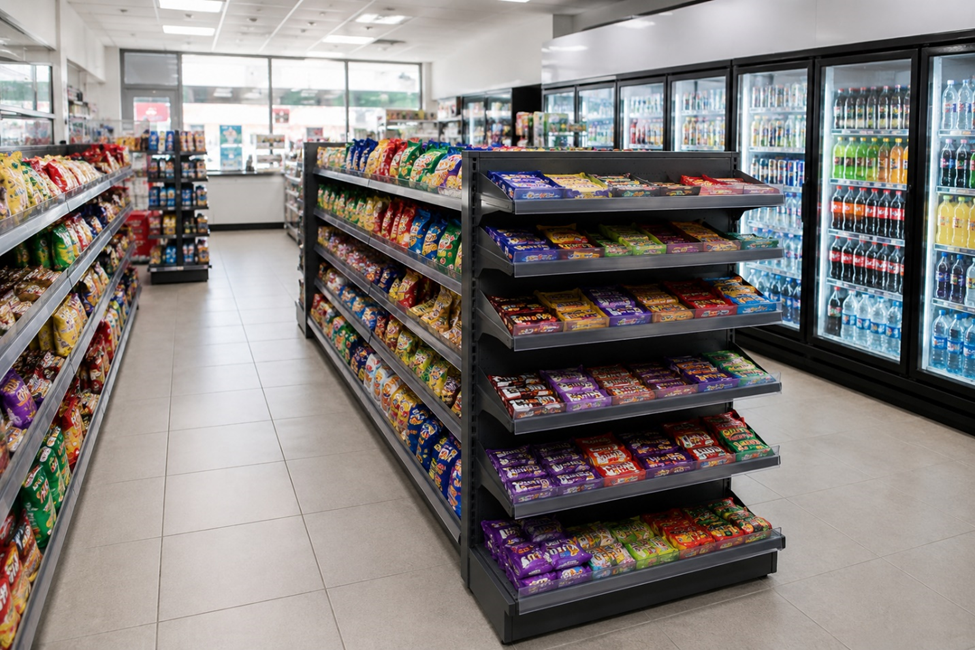
Convenience stores have to fit a surprisingly broad product range into a relatively small footprint. Drinks, snacks, groceries, household essentials and impulse products all compete for space, while customers still need clear aisles and an easy path to the checkout.
That makes shelving more than a fixture decision. The wrong system can limit product visibility, make restocking harder and leave retailers with a layout that becomes difficult to change as the business evolves.
Here are some of the most common mistakes retailers make when choosing convenience store shelving, and what to consider instead.
1. Choosing Shelving Based on Price Alone
Keeping fit-out costs under control is important, particularly when opening a new store. However, choosing shelving purely because it has the lowest upfront price can create additional costs later.
Commercial shelving is used continuously. Products are replenished, shelves are adjusted and customers interact with the fixtures throughout the day. A system that is not designed for this level of use may need repairs, replacement components or complete replacement sooner than expected.
Instead of comparing purchase prices alone, retailers should consider durability, load capacity, component availability and how long the system is expected to remain serviceable.
The better question is not simply, “How much does this shelving cost?” but “What value will it provide over the life of the store?”
2. Using Shelving That Is Not Designed for Convenience Retail
Not every shelving system is suited to a convenience store.
Fixtures designed primarily for storage, offices or other low-traffic environments may not provide the flexibility required for a retail floor. Convenience stores frequently need to accommodate products with very different dimensions while maintaining good visibility and allowing staff to replenish stock efficiently.
Purpose-designed shelving for convenience stores can make it easier to combine wall runs, central gondolas and adjustable shelf configurations around the store’s actual product mix.
The goal should be to select a system that supports retail merchandising rather than trying to make a general-purpose storage system perform a job it was not designed to do.
3. Failing to Plan the Layout Before Ordering
One of the easiest mistakes to make is deciding how many shelving bays to buy before properly planning the store.
Shelving needs to work alongside refrigeration, checkout counters, entrances, promotional areas and other fixtures. Its height and position can also affect sightlines across the store.
A simple floor plan can help retailers establish where wall shelving and central gondolas should sit before finalising quantities. It also provides an opportunity to consider aisle widths and customer circulation.
Accessibility should be part of this process as well. Depending on the premises and nature of the fit-out, Australian retailers may need to consider applicable requirements under the National Construction Code and relevant accessibility standards.
Planning the complete space first reduces the risk of discovering after delivery that the selected configuration makes an aisle unnecessarily narrow or blocks an important line of sight.
4. Overlooking the Products That Will Actually Go on the Shelves
A shelving system can look perfectly suitable on paper and still perform poorly once merchandise is loaded onto it.
A convenience store may carry lightweight confectionery alongside large drink bottles, canned goods, household products and other comparatively heavy or bulky items. These categories do not necessarily need the same shelf depth, spacing or load capacity.
Retailers should therefore map their major categories before finalising the shelving configuration.
Consider the dimensions and approximate weight of the products, how many facings are required, how frequently the category is replenished and whether its space allocation is likely to change. This makes it easier to select shelf sizes and configurations that suit the merchandise rather than forcing the merchandise to fit the fixtures.
5. Trying to Fit Too Much Shelving Into the Store
Floor space is valuable, so there is an understandable temptation to use as much of it for merchandise as possible.
But adding another shelving run does not automatically make the store more productive.
Overcrowded layouts can make aisles feel cramped, reduce visibility and make it harder for customers to browse comfortably. Tall or poorly positioned gondolas can also obstruct views across smaller stores.
Retailers should instead think about how effectively each section of the floor is being used. Sometimes a slightly more open layout can provide clearer product presentation and easier navigation without significantly reducing useful display capacity.
The objective is not to maximise the number of shelves. It is to make the available space work efficiently.
6. Ignoring Adjustability and Future Changes
A convenience store’s product range rarely remains exactly the same.
New brands enter the market, promotions come and go, seasonal products require temporary space, and some categories grow while others shrink. Shelving that works perfectly when a store opens may therefore need a different configuration a year later.
This is where adjustability becomes important.
Modular systems allow shelf positions, quantities and accessories to be changed without replacing the entire fixture. They can also make it easier to allocate more space to a growing category or reduce the footprint of one that is no longer performing as strongly.
Based on experience working with Australian retailers, Mills Shelving has found that this flexibility becomes particularly valuable when stores need to change category allocations without undertaking another substantial fit-out.
7. Forgetting About Replacement Parts and Accessories
Retailers often spend considerable time comparing shelving systems but much less time considering whether compatible components will still be accessible when the store needs them.
A damaged shelf may eventually need replacing. A growing category may require another shelf. A new range might display better with hooks, dividers or other merchandising accessories.
If compatible components are difficult to source, what should be a relatively simple adjustment can become a larger problem.
Mills Shelving recommends considering the availability of additional shelves, brackets and accessories as part of the original purchasing decision. Expandability matters because a good commercial shelving system should be capable of changing with the store rather than becoming obsolete every time the merchandising strategy changes.
Think Beyond the Opening-Day Fit-Out
According to Neil Webster, CEO of Mills Shelving, retailers should think about how their shelving will perform several years after installation, not simply how it looks on opening day. A strong system should be durable enough for everyday retail use while giving the store flexibility to adjust shelf positions, add compatible components and respond to changes in its product mix. Planning for those requirements early can prevent unnecessary limitations as the business develops.
8. Not Considering Restocking and Day-to-Day Operations
Customers are only one group that needs to use the shelving effectively.
Employees may replenish the same sections several times a day, particularly for fast-moving products such as chilled drinks, snacks and confectionery. Poor shelf positioning or unnecessarily complicated configurations can make routine replenishment slower than it needs to be.
Retailers should consider how staff will access stock, rotate products and maintain displays when planning each section.
The best layout should work both when customers are browsing and when employees are trying to restock efficiently during a busy trading period.
Choose Shelving for the Store You Need Long Term
Choosing convenience store shelving involves more than filling available wall and floor space.
Retailers need to consider what will be displayed, how customers will move through the store, how frequently products will be replenished and how the merchandise mix could change over time. Durability, adjustability and access to compatible components can be just as important as the initial appearance and price.
By planning the layout first and selecting shelving around real operational requirements, retailers can create a store that works effectively from opening day while remaining flexible enough to adapt in the years ahead.
