
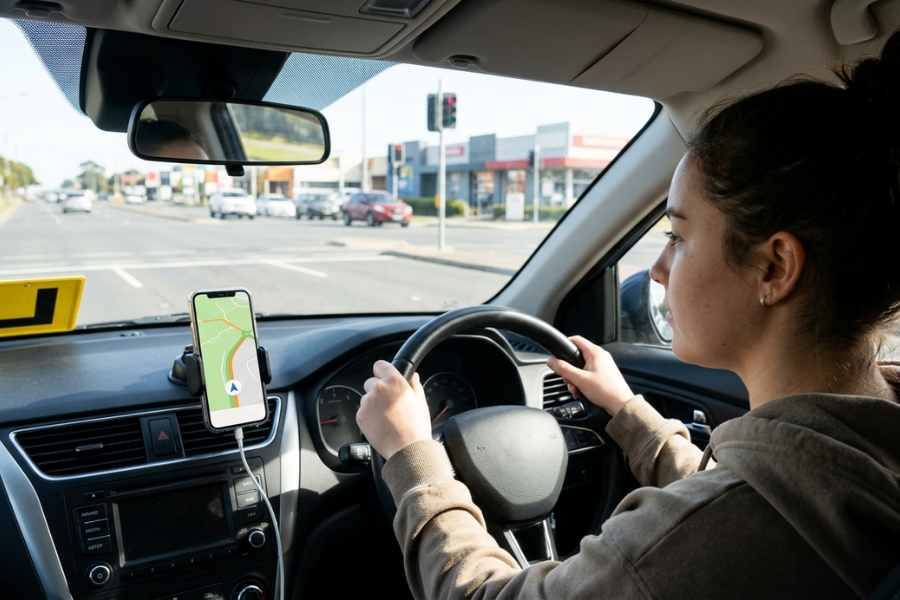
You’re running late, heading somewhere you’ve never driven before, and you’re relying on Google Maps to guide you there. What could go wrong? After all, your phone is telling you exactly where to go, so you just have to follow its directions closely. Easy, right? Not quite. If you’re a learner driver, reaching for your phone to check the next turn can create a problem you didn’t expect. Understanding the rules before you set off can help you stay focused, avoid distractions, and feel more confident behind the wheel. Whether you’re taking driving lessons with a Sydney Driving School or practising with a supervising driver, learning how to navigate without relying on your phone is an important part of becoming a safer, more independent driver.
Can Learner Drivers Use GPS Apps?
There is no common rule in Australia regarding mobile phones that applies to all learner drivers. Each state and territory has its own mobile phone laws, so what is permitted can vary depending on where you are driving. In NSW, the rules are particularly strict. You cannot use a mobile phone while driving, including using its GPS or navigation functions. This applies even if the phone is mounted in a cradle or connected hands-free. So, if you’re an NSW learner, putting your phone in a holder does not make it legal to use Google Maps while you are driving.
What About a Phone Mounted in the Car?
This is an easy one to get confused about. You may have seen fully licensed drivers using a phone mounted on the dashboard for navigation and assumed the same rules apply to you. They don’t necessarily. For unrestricted NSW drivers, a phone can be used as a navigation aid when it is secured in an appropriate fixed mount. Learner and provisional drivers have different restrictions, so it is important not to assume that rules applying to experienced drivers also apply to you.
How Can Learners Navigate Safely?
The safest approach is to plan your route before you start driving. Check where you are going, familiarise yourself with the main roads and intersections, and set up any permitted navigation equipment before moving off. If you are travelling with a supervising driver, they can help with directions while you concentrate on the road. During a driving lesson, your instructor can also help you become more comfortable navigating unfamiliar roads without relying on your phone. And if you miss a turn, don’t panic. It is far safer to continue driving and find a safe way to turn around than to look down at your phone while moving.
Don’t Let GPS Replace Your Awareness
Navigation apps can tell you where to go, but they cannot replace your own observation. As a learner, you still need to watch for signs, lane markings, intersections, pedestrians, cyclists, changing traffic conditions, and unexpected hazards. Learning to read the road yourself will make you a more confident driver when you eventually drive without someone beside you.
Build Safer Navigation Habits
A good driving school can help you develop these habits in real-world situations. With guidance from an instructor, you can practise following road signs, choosing the correct lane, and handling unfamiliar routes while keeping your attention where it belongs. For eligible learners, the Safer Drivers Course can also help build a stronger understanding of risk, decision-making, and safer driving strategies.
Check the Rules Before You Drive
GPS can make getting around much easier, but it should never come at the cost of your attention or safety. If you’re a learner in NSW, make sure you understand the mobile phone restrictions before setting off, and plan your navigation in advance.
Ready to feel more confident navigating unfamiliar roads? Book a driving lesson with a reputed Sydney Driving School, like Onroad Driving School, and practise making safe decisions without relying on your phone. Building these habits now can help you become a more confident, independent driver after you get your licence.
