
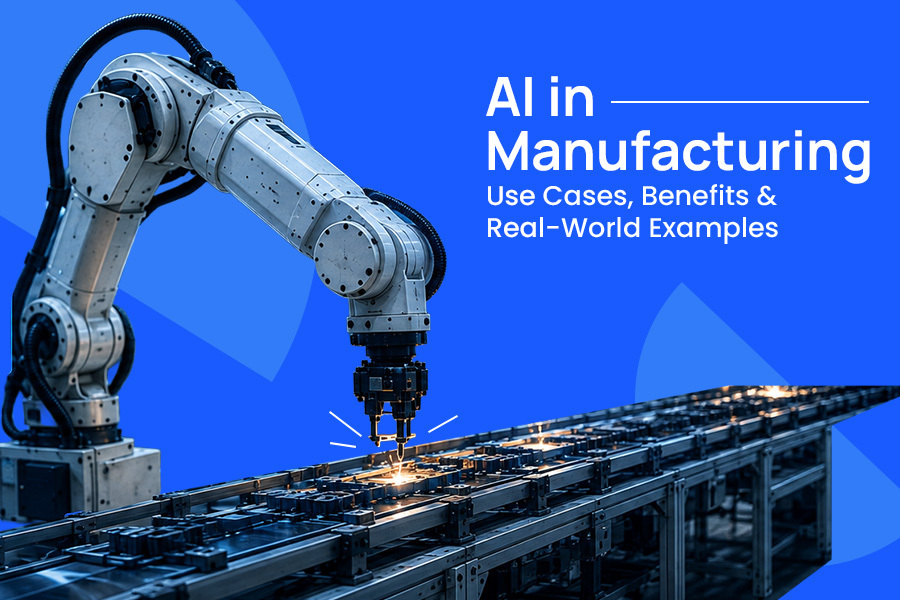
As technology advances, the focus is on integrating AI in manufacturing in every possible system. It is helping the manufacturing industry improve production efficiency, reduce downtime, optimize supply chains, and make operational decisions. Enterprise AI has become a strategic investment rather than an experimental technology.
It is important to understand that AI adoption is not about deploying AI Models. The manufacturing business requires AI data engineering to train the Enterprise AI, reliable data pipelines for LLM applications to feed the required messages to the queries, and an enterprise data platform to manage all data in one place. It enables AI systems to access accurate business information across operations.
How Enterprise AI Is Transforming Manufacturing
ERP systems, MES, IoT sensors, PLCs, quality inspection systems, and supply chain applications all produce massive amounts of data in modern manufacturing. Important insights are lost if these systems are not connected.
By connecting these data sources, enterprise AI solutions facilitate intelligent decision-making across departments, enhance operational visibility, and automate workflows. This enables manufacturers to transition from reactive to data-driven and predictive manufacturing.
AI Use Cases And Benefits in the Manufacturing Industry
1. AI for Operations
The operations team manages essential tasks such as turning raw materials into finished goods through production planning, quality checks and machine services. Using AI for Operations, teams receive real-time insights to make quicker business decisions. It can help manufacturers track production performance, spot bottlenecks, enhance scheduling, and make better use of resources.
2. Predictive Maintenance
In Tier-2 companies, where manufacturing is conducted in bulk and requires proper inspection.
Industrial equipment can generate continuous sensor data. Using industrial artificial intelligence, manufacturers can reduce expensive unplanned downtime, schedule maintenance in advance, and identify early signs of equipment failure.
3. AI-Powered Quality Control
The biggest issue for any manufacturing company is managing quality throughout the production process. For that, lots of manpower is required to check every little detail. But with Enterprise AI, manufacturers can identify flaws more quickly and consistently with computer vision and AI-powered inspection systems. It increases product quality and reduces waste.
4. AI Automation & Agentic AI
Many processes are continually repeating in a business, and employees need to take care. AI automation and Agentic AI streamline these repetitive processes in production, finance, customer service, and procurement.
AI agents can perform information retrieval, task coordination, approval triggering, and daily operational processes for staff members.
5. Intelligent Knowledge Systems
Engineers and operations teams can use natural language queries to extract information from SOPs, maintenance logs, technical manuals, and enterprise documents by combining Large Language Models (LLMs) with data pipelines for LLM applications.
Indian Manufacturers Real-World Examples
Indian manufacturers have already demonstrated how AI can provide measurable operational value.
Tata Steel
Throughout their manufacturing value chain, they are utilizing AI for digital operations, process optimization, quality enhancement, safety monitoring, and predictive maintenance. The business claims to use hundreds of AI models to enhance productivity, decision-making, and equipment reliability.
Hyundai Motor India
Through an industrial data network, it has linked over 2,000 vital factory equipment to enable automated quality checks, predictive maintenance, and quicker production decisions.
Vedanta, Larsen & Toubro (L&T), and Godrej Enterprises
They are incorporating digital technologies, automation, artificial intelligence, and predictive analytics throughout manufacturing processes. It is assisting them in increasing output and operational efficiency.
These real-life examples are proof that Indian manufacturers are using AI to enhance daily factory operations.
Why Data Engineering Is Essential For Enterprise AI
Many AI projects face difficulties because enterprise data is still scattered across ERP, MES, CRM, IoT devices, and legacy systems. That’s why AI data engineering becomes crucial in this situation. Manufacturers can synchronize operational data, enhance data quality, and establish structured data pipelines by developing reliable enterprise data platforms. Even the most sophisticated AI in the Enterprise cannot produce accurate business insights without trustworthy data.
The Future of AI in Manufacturing
The future of manufacturing belongs to organizations that can transform operational data into intelligent business decisions.
Manufacturers who invest in Enterprise AI will have a competitive edge. As AI adoption picks up speed, businesses can focus on developing interconnected AI ecosystems. These systems integrate production, quality, maintenance, procurement, and supply chain operations.
